

Ceramic Coating
Only with added purchase of our Wheels-Off Package. This package includes the removal of wheels for access to suspension components, brake calipers and wheel wells. Everything will receive thorough deep cleaning, and your wheels will be will be cleaned and ceramic coated inside and out. This package also includes ceramic coating brake calipers when applicable.
No, but ceramic coating will offer protection against acid etching and UV exposure. If you're looking for protection against rock chips and scratches, we would need to look into Paint Protection Film.
Our packages are designed based on how you plan to care for the vehicle and length of ownership. When you bring us your vehicle, we can evaluate and discuss our recommended options with you.
It is not recommended to use these car washes. This type of car wash WILL scratch your paint. It is best to hand wash or use a touchless car wash.
We have multiple packages that include coatings that last between two and ten years, depending on which options you choose.
We recommend waiting ten days before washing your car after it's been coated. Rain and outdoor elements will not harm the curing process during that time.
We recommend using a pH balanced car wash shampoo, wool wash mitt and a microfiber towel. We highly recommend maintaining the wheels with P&S Beadmaker to prolong the durability of the coating.
Let’s face it, a car is a not an investment. It is a liability. Over time, natural wear and tear as well as adverse affects from mother nature can take a toll on your vehicle. With our protection and preservation services, paint and body damage can be prevented and your vehicle will be able to maintain a constant state of perfection while providing you with peace of mind, ease of maintenance and retain value.
Paint Correction
This is the most crucial step prior to a multi-stage paint correction. The thought of having multiple high speed tools touching your vehicle’s paint surface is often times daunting. While this commonly happens at most dealerships and inexperienced detail shops, here at American Detail, it is our number one priority to produce the most striking result without creating further damage. The vehicle is thoroughly inspected using multiple light sources including high powered LEDs and direct sunlight to reveal all imperfections. The next step is to measure the paint’s clear coat using a digital paint depth meter to make sure there is enough clear coat to work with. This is a very important process and is commonly overlooked by most detailing shops. It determines the thickness of the paint and the likelihood of burning through the clear coat. All panel edges, plastics and sensitive areas will be protected using body-safe masking tapes, which is another step most detailing shops will ignore. Masking these areas will prevent the buffer from burning through the clear coat, since the paint is always the thinnest towards the edge of the panels.
Multi-stage paint correction can be defined as re-leveling, rejuvenation, and renovation. Here at American Detail, it is the usage of high-tech tools and materials coupled with knowledge and experience to remove any swirl marks, spider webbing, scratches, water spots, bird dropping etchings, and other paint defects. Our expertise lies in restoring your car's paint to a better-than-new condition, revealing an optically clear and smooth finish.
It is a common misconception that a brand new vehicle requires no paint correction and that the paint is fresh from the factory. It is the dealership's usual practice to do a "new car prep" before delivering to the customer. Dealerships will always use the fastest and cost effective way to prep the car, which inevitably creates imperfections. In addition to that, the dealership detailers uses a body shop glaze and a combination of high speed machines with dirty wool pads to create a temporary "show car shine" under the showroom lights. This merely helps to create extra gloss, hiding all imperfections.
All new cars have imperfections to some degree that we are able to correct.
Paint Protection Film (PPF)
PPF offers protection, peace of mind, and retains your vehicle's value. Imagine having a protective bubble around your car. Our paint protection film combines best-in-class durability and clarity not previously available in the market. Our exclusive line of Clear PPF offers best in class hydrophobic properties, anti-contamination and anti-yellowing. In addition, the film employs special polymers that “self-heal” eliminating swirl marks and other fine scratches without having to do anything. If the PPF is ever to be removed, the paint underneath will be as flawless as it was on the day the film was installed.
XPEL warranties Paint Protection Film to be free from defects in materials and workmanship for ten (10) years from the date of purchase. Covered defects include: yellowing, staining, cracking, blistering and delaminating. This warranty does not extend coverage to damage caused by normal wear and tear, road debris impact, accidents, collisions or intentional damage of any kind.
Let’s face it, a car is a not an investment. It is a liability. Over time, natural wear and tear as well as adverse affects from mother nature can take a toll on your vehicle. With our protection and preservation services, paint and body damage can be prevented and your vehicle will be able to maintain a constant state of perfection while providing you with peace of mind, ease of maintenance and retain value.
Detailing
Value: Your car is a direct representation of you. It embodies what the owner has accomplished through hard work and determination and hence should be treated as such. The caliber of detailing a car directly represents how well the owner maintains it as an asset. Over time, natural wear and tear as well as adverse affects from mother nature can take a major toll on your vehicle. With our restoration and preservation services, paint and body damage can be prevented and your vehicle will be able to maintain a constant state of perfection.
Protection: High end detailing not only provides a stunning finish, it protects the overall condition of the vehicle and helps maintain its value. As consumers of the finer things in life, we take special pride in our own vehicles as well as our client’s cars to ensure that we deliver the highest level of paint protection to have long lasting results.
Projection: The first impression is the lasting impression. Maintaining a well manicured vehicle projects a certain image and a preconceived notion about how the owner takes care of valuable items. Having a neatly cared for vehicle projects pride in ownership and respect for the vehicle. Don’t ruin first impressions with poor detailing and care. The next time someone takes a glance at your car, you want them to think perfection.
The condition of your interior and the results you're looking to achieve will determine which package is right for you. When you bring us your vehicle, we're more than happy to evaluate and discuss which option we recommend.
The condition of your exterior and the results you're looking to achieve will determine which package is right for you. When you bring us your vehicle, we're more than happy to evaluate and discuss which options we recommend.
An acid-free, pH-balanced iron remover is utilized during washes to break down imbedded iron deposits from all painted surfaces, including wheels. This helps ensure a surgical level of cleanliness before moving on to other stages.
Using soaps as lubricants, clay bar is rubbed over all painted surfaces and pulls imbedded contaminants out of the clear coat. This leaves behind an extremely smooth, contaminant-free surface.
American Detail utilizes the 3-Bucket System using pH neutral foam shampoo and deionized water which effectively cleanses without stripping the protection on your vehicle.
Tint
We recommend that you leave your windows up for 72 hours (3 days) after they are tinted. This will allow the film time to adhere to the glass so it will not peel when it is finally rolled down.
Yes. All Xpel window films are fully backed by our manufacturer’s warranty.
Unlike window film, factory tint is a pigment within the glass that’s installed during the manufacturing process. There is no way to remove that from the glass. The only alternative to getting the same benefits of window film is to install window film over the factory tint.
General
American Detail was started and created for the passionate automotive enthusiasts. This passion runs deeps in our company and is apparent in the level of quality in our work. American Detail provides a wide range of services to suit your needs. Our quality and professionalism is guaranteed and unrivaled across the Greater Houston Area. Technology is always changing and we at American Detail constantly maintain a pulse on the latest products available in the automotive industry. Our network of knowledgeable detailers reaches all over the world, and our research into the latest products and methods gives us the advantage to provide your vehicle with the care it deserves. Not only do we provide our customers with the highest level of service, we also educate them on how to properly detail and maintain the vehicle throughout their ownership. We take great pride in each vehicle we service and work only a select few at a time so each client’s vehicle can receive the undivided attention it deserves. We are committed to providing only the highest level of service and dedication, and we promise to take care of your vehicle as if it were one of our own.
Yes, we are fully insured.
All American Detail technicians are required to pass the Certified Detailer Test administered by the International Detailing Association. American Detail is trained annually at SEMA and we train with the Detail Mafia. American Detail uses the best products available and we are certified to install Opti-Coat Pro, Ceramic Pro and Gtechniq. Technology is always changing and we at American Detail constantly maintain a pulse on the latest products available in the automotive industry. Our network of knowledgeable detailers reaches all over the world. Our research into the latest products and methods gives us the advantage to provide your vehicle with the care it deserves.
We handle this on a case-by-case basis, but ideally you would have someone follow you to our shop when you go to drop-off your vehicle.
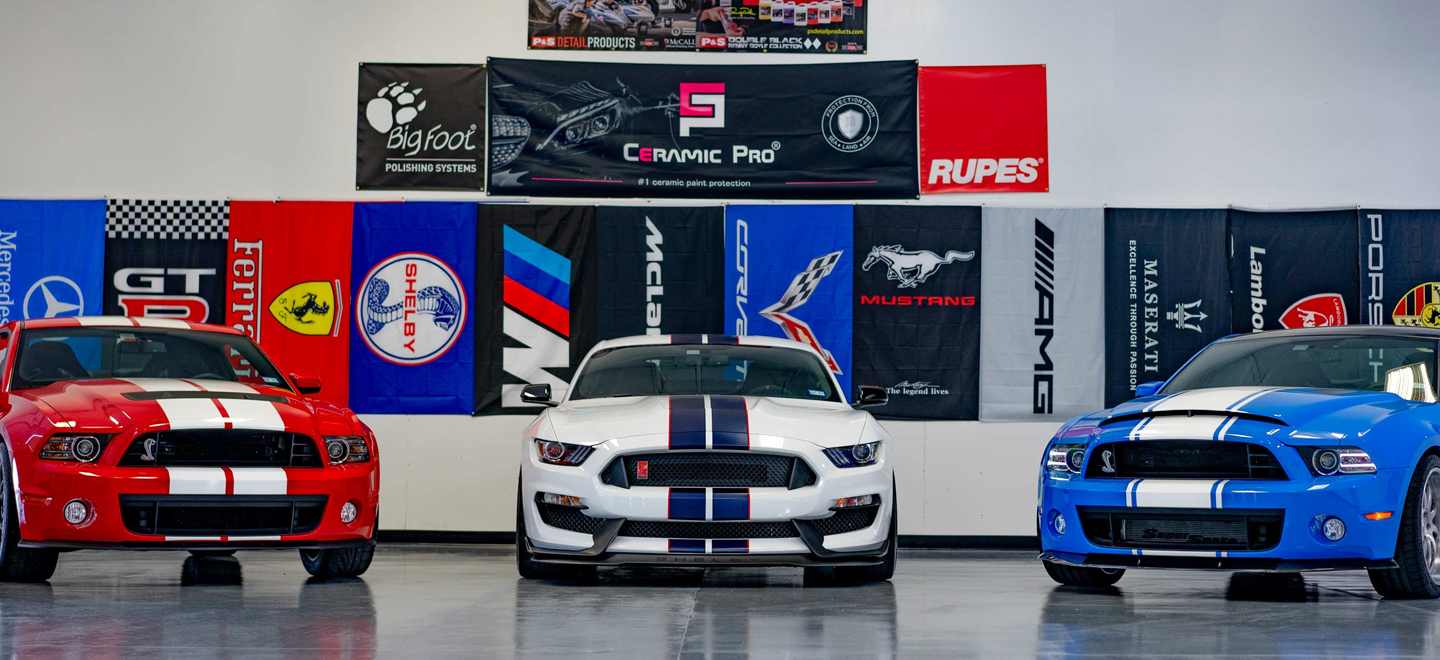
No. At American Detail , we believe every car deserves proper care and protection. Our customer base has a wide range of vehicles including Audi, BMW, Mercedes, Lexus, Acura, Infiniti, Toyota, Nissan etc. Our primary showcase focuses on exotics and luxuries, but we provide services for the daily driver as well. We pride ourselves for being the first choice when it comes to being the premier auto detailing salon in Houston, TX.
Let’s face it, a car is a not an investment. It is a liability. Over time, natural wear and tear as well as adverse affects from mother nature can take a toll on your vehicle. With our protection and preservation services, paint and body damage can be prevented and your vehicle will be able to maintain a constant state of perfection while providing you with peace of mind, ease of maintenance and retain value.